
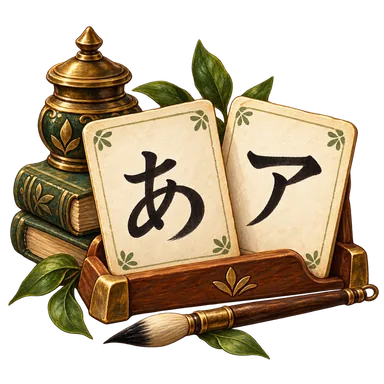
The same sounds can be written in two kana scripts. Use the chart and examples to see why a word is written one way rather than the other.
The idea
Hiragana normally represents Japanese sound units. The 46 basic signs include vowels, consonant–vowel combinations and ん; small signs and marks make further sounds. Hiragana also writes particles and verb endings alongside kanji, such as を and ます. The chart pairs five signs with their katakana counterparts. Katakana represents the same sound system as hiragana. It commonly writes loanwords, many foreign names and sometimes words for emphasis. In コーヒー, each ー lengthens the preceding vowel; compare the kana pairs in the chart before reading the examples.
| Hiragana | Katakana |
|---|---|
| あ | ア |
| か | カ |
| さ | サ |
| た | タ |
| な | ナ |
Examples
- 犬は小さいです。The dog is small.
- 机の上に本があります。There is a book on the desk.
- コーヒーを飲みます。I drink coffee.
- パンを買います。I buy bread.
- バスで駅へ行きます。I go to the station by bus.
- ノートに名前を書きます。I write my name in a notebook.
Read-aloud uses a synthetic Japanese voice available on your device. Voice quality and availability vary; it does not assess your pronunciation.
No Japanese device voice is available. You can still read the text and use the linked listening resources.
Watch out
Katakana is a script, not a promise that a loanword sounds or means exactly like its source. Keep both long marks in コーヒー; a missing mark changes the timing.
Try it yourself
「パン」の書き方は?(ひらがな/カタカナ)
Show answer or example answer
カタカナ
パン is written in katakana, a common choice for loanwords.
「を」の書き方は?(ひらがな/カタカナ)
Show answer or example answer
ひらがな
を is a grammatical particle written in hiragana.
「ます」の書き方は?(ひらがな/カタカナ)
Show answer or example answer
ひらがな
ます is a polite verb ending written in hiragana.
Practice round
Answer questions, then rebuild Japanese sentences where available. We keep your score.
「パン」の書き方は?(ひらがな/カタカナ)
「を」の書き方は?(ひらがな/カタカナ)
「ます」の書き方は?(ひらがな/カタカナ)
Tap the words in the right order.
Tap the words in the right order.
Tap the words in the right order.
Keep your progress
Sign up for free to save your practice results in your account.
Sign up to saveI already have an accountUse it today
Cover the chart. Read two words from the examples aloud, write their readings in kana from memory, then compare them with the furigana and chart.