
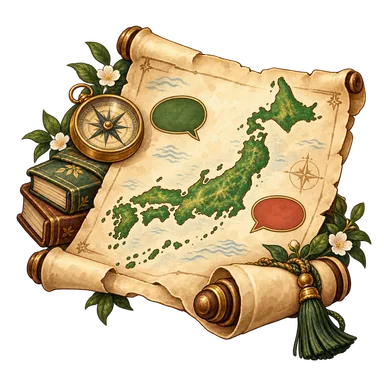
Japanese has many regional varieties. Common standard Japanese is useful across regions; local speech is also a living part of everyday life.
The idea
The examples use standard polite Japanese. In some Kansai speech, おおきに expresses thanks and ちゃう corresponds to plain 違う. Usage varies by place, speaker and situation. ありがとうございます is a polite standard way to thank someone; listen to the setting before choosing a register.
| Japanese | Meaning |
|---|---|
| おおきに | Kansai: thanks |
| ちゃう | Kansai, informal: different / not so |
| ありがとうございます | standard: polite thanks |
Examples
- 今日は良い天気ですね。The weather is nice today, isn’t it?
- 手伝ってくれて、ありがとうございます。Thank you for helping me.
- それは私の本ではありません。That is not my book.
- 道を教えてください。Please tell me the way.
- 明日、また会いましょう。Let’s meet again tomorrow.
- この店の料理はおいしいです。The food at this shop is delicious.
Read-aloud uses a synthetic Japanese voice available on your device. Voice quality and availability vary; it does not assess your pronunciation.
No Japanese device voice is available. You can still read the text and use the linked listening resources.
Watch out
A region does not determine how every resident speaks. The informal ちゃう is not appropriate for every formal setting.
Try it yourself
Choose the standard expression of thanks corresponding to Kansai おおきに. 関西の「おおきに」→共通語の「_」。(ありがとう/さようなら)
Show answer or example answer
ありがとう
おおきに is a Kansai expression of thanks; ありがとう is a standard plain equivalent.
Choose the standard plain equivalent of Kansai ちゃう. 関西の「ちゃう」→共通語の「_」。(違う/行く)
Show answer or example answer
違う
ちゃう can mean 違う in Kansai speech; both forms here are informal.
Thank someone politely. 丁寧に感謝します。_。(ありがとうございます/さようなら)
Show answer or example answer
ありがとうございます
ありがとうございます expresses thanks politely in standard Japanese.
Practice round
Answer questions, then rebuild Japanese sentences where available. We keep your score.
Choose the standard expression of thanks corresponding to Kansai おおきに. 関西の「おおきに」→共通語の「_」。(ありがとう/さようなら)
Choose the standard plain equivalent of Kansai ちゃう. 関西の「ちゃう」→共通語の「_」。(違う/行く)
Thank someone politely. 丁寧に感謝します。_。(ありがとうございます/さようなら)
ありがとうございます
Tap the words in the right order.
Tap the words in the right order.
Tap the words in the right order.
Keep your progress
Sign up for free to save your practice results in your account.
Sign up to saveI already have an accountUse it today
Listen to a labelled regional example, identify its meaning, then say a polite standard equivalent in your own situation.